ROH is delighted to present works by Thảo Nguyên Phan (b. 1987, HCMC, Vietnam) at the Emergence sector of Art Basel Paris 2026. Trained in fine arts painting, Phan returns here to the lacquer and silk techniques central to her education, underscoring their enduring role within her broader multimedia practice. Inherently abstract and mediated, these mediums shape a parafictional lens that sustains ambiguity through Vietnamese painting, opening alternative ways of imagining across intertwined realities.
Phan was trained as a painter at the Ho Chi Minh City University of Fine Arts, receiving an education shaped by the French syllabus of the École des Beaux-Arts de l'Indochine. Her expansion into multimedia practice developed during her studies in Chicago, where encounters with experimental video art and mentorship with Joan Jonas recalibrated her sense for the richness of a practice without hierarchy of materials. From this emerged the cross-media work for which Phan is now known: installations and moving image works that layer archival imagery, animation, sound, and painting into composite narratives. Her stories are partial and resistant to linear narration, referencing obscured official histories. Phan is also a co-founder of Art Labor, a cross-disciplinary collective developing community-engaged projects, a double commitment to the intimacy of studio practice and the social life of art that inflects the scale and address of her work. She draws on literature, philosophy, animist belief systems, and Southeast Asian concepts of reincarnation and oral traditions, while insisting on the specificity of her materials: how a medium behaves and what it remembers.
"Opaque Fragile” focuses on Phan’s painting practice, elucidating the ways in which these ideas have been intrinsic to her approach to painting as a poetic tool, whose qualities and processes enact the unexhausted potential of ambiguity in Vietnamese painting and abstraction. Layers of natural pigments are built up and sanded underwater until time and labour are obscured within a single plane. Phan likens this process to the Mekong River (a frequent subject in her works) carrying alluvium to nurture the delta. And if lacquer thinks through care and accumulation, her silk paintings operate through a dialogue among multiple images at once, abstracted structural forms and background sceneries mutually affecting each other in a shifting relationship. These forms are inspired by the brise-soleil structures of postcolonial modern architecture, informing aspirations of independence while filtering the intensity of tropical light and air, or here, diffusing the directness of the conditions they carry. In certain works, the grid emerges as a guiding principle; in others, forms fracture into cartographies or cosmos, figures or the shimmering wings of a sail.
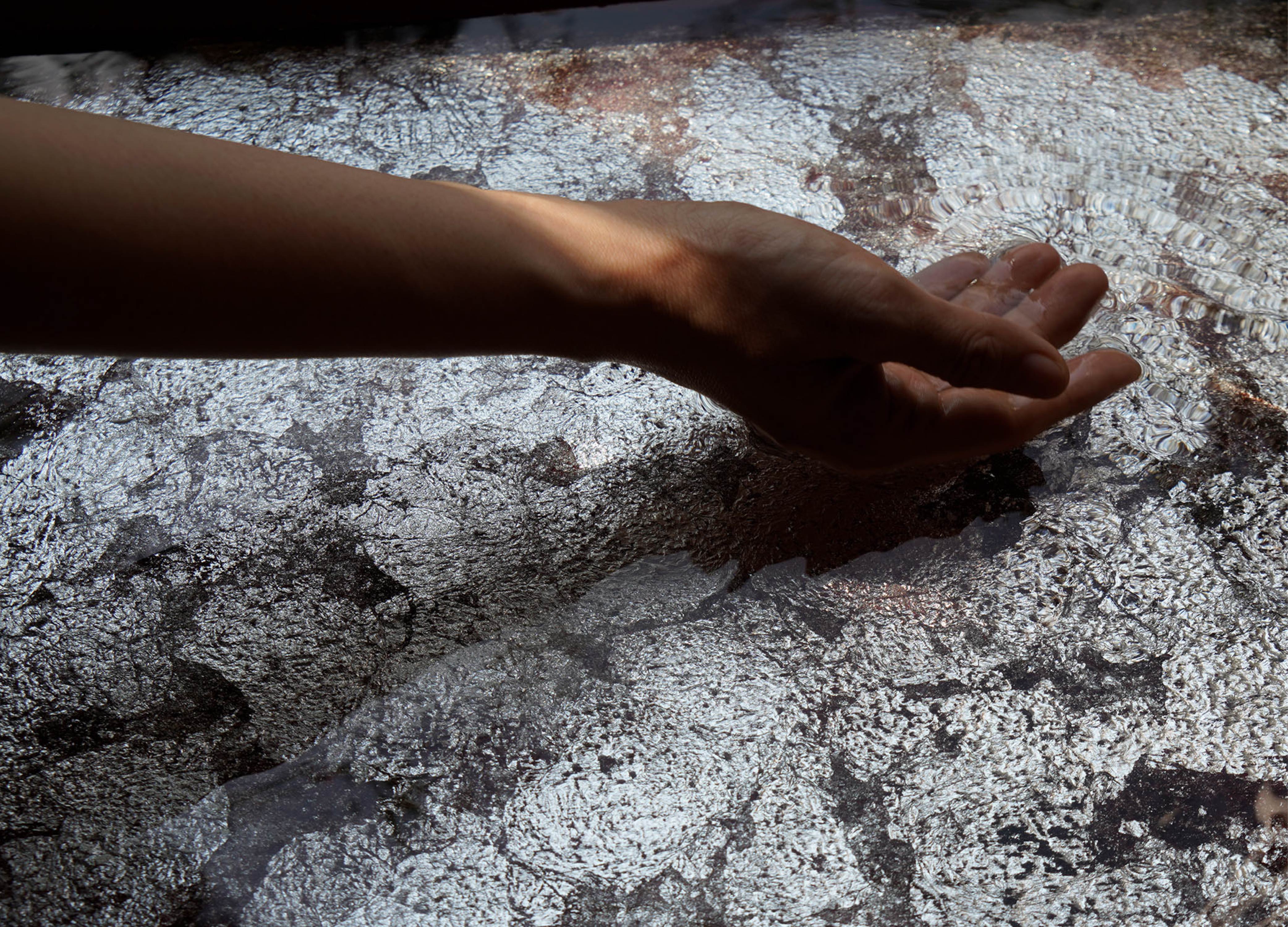
This aestheticism animates the presentation's floor work, informed by Kawabata's short story "The Moon in the Water" (1953): a reversed frame resting on the ground contains water in which gold and silver leaf float. Exposing the raw materials of her paintings in a state of inherent mutability, the work returns light and the viewer's gaze into the surrounding environment. Just as Kawabata's prose pursued a world glimpsed through mirrors and dreams, interpretation gathers and disperses across Phan's basin, reflecting the tenuous balance of mimesis, reflection, and imagination that runs throughout her practice.
Phan's works consistently elude easy reading. Beyond a material state, opaqueness is a withholding of information that understands painting's resistance to knowledge as a form of compassion, declaring itself as a mediated response to its subjects. This propensity for a parafictional lens responds to her recognition that inherited official histories are ultimately fragile fictions bent toward victors. In their provisional presence, her paintings ease new modes for imagining through reality.
ARTIST
B. 1987, Ho Chi Minh City, Vietnam
Lives and works in Ho Chi Minh City, Vietnam.
Trained as a painter, Phan is a multimedia artist whose practice encompasses video, painting and installation. Drawing from literature, philosophy and daily life, Phan observes ambiguous issues in social conventions and history.
Phan exhibits internationally, with solo and group exhibitions including In Interludes and Transitions at The Diriyah Contemporary Art Biennale, Saudi Arabia (2026); Le Soleil Tombe Sans Un Bruit at Palais de Tokyo (Paris, France, 2025), Pirelli HangarBiccoca (Milan, Italy, 2023); Venice Art Biennial (Venice, Italy, 2022); Tate St Ives, (Cornwall, UK, 2022); Chisenhale gallery (London, 2020); WIELS (Brussels, 2020); Rockbund Art Museum (Shanghai, 2019); Lyon Biennale (Lyon, 2019); Sharjah Biennial (Sharjah Art Foundation, 2019); Dhaka Art Summit (2018); Para Site (Hong Kong, 2018); Factory Contemporary Art Centre (Ho Chi Minh City, 2017); Nha San Collective (Hanoi, 2017); and Bétonsalon (Paris, 2016), among others.
She was shortlisted for the 2019 Hugo Boss Asia Art Award. She was granted the Grand Prize, APB Foundation Signature Art Prize, Singapore Art Museum and the Han Nefkens Foundation-LOOP Barcelona Video Art Production Award 2018, in collaboration with Fundaciò Joan Miró. In addition to her work as a multimedia artist, she is co-founder of the collective Art Labor, which explores cross disciplinary practices and develops art projects that benefit the local community. Thảo Nguyên Phan is expanding her “theatrical fields”, including what she calls performance gesture and moving images. Phan is a 2016-2017 Rolex Protégée, mentored by internationally acclaimed, New York-based, performance and video artist, Joan Jonas.
View Artist