Nuntun, Nata, Nonton
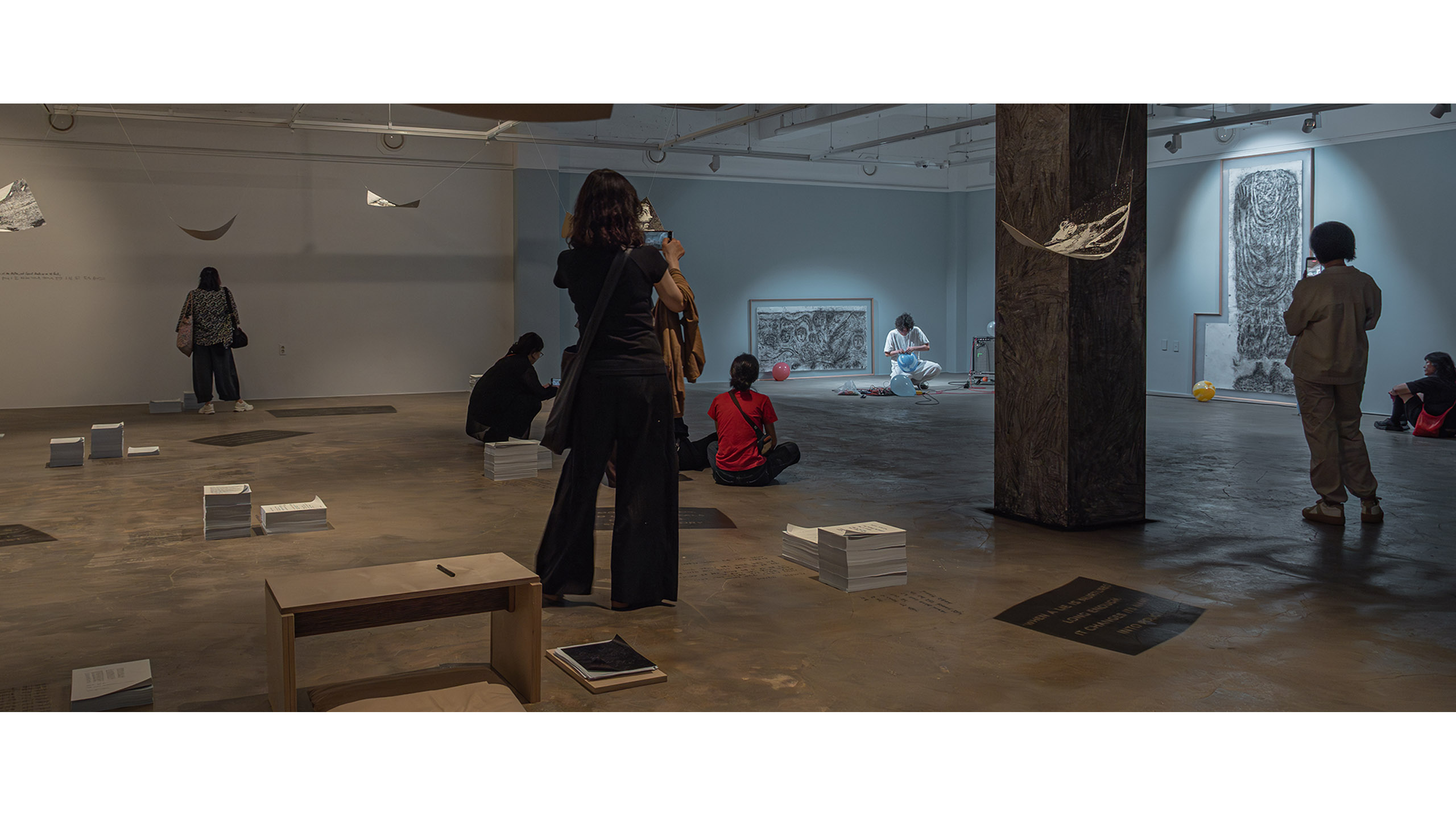
There are three Javanese words for what inherited wisdom needs in order to keep travelling: tuntunan, how it teaches; tatanan, how it is held in order; tontonan, how it comes to be seen. The vocabulary belongs most clearly to wayang, though the challenge is common to any inheritance of knowledge. All three are nouns for what an action leaves behind. In this pavilion, they are returned to their verbs. ikkibawiKrrr (established 2021, South Korea) and Aditya Novali (born 1978, Indonesia) meet across that turn, investigating how forms of wisdom survive, who holds authority over them, and what they become when released. Nuntun is teaching by accompaniment rather than instruction, and only for as long as someone is doing it. Nata is the arranging, and the authority that comes with it. Nonton is left to you.
Wisdom no longer held by a single keeper is not lost. It waits to be met by whoever arrives ready to receive it. This pavilion holds a door open for the length of a visit, so that we may still belong while everything else changes.
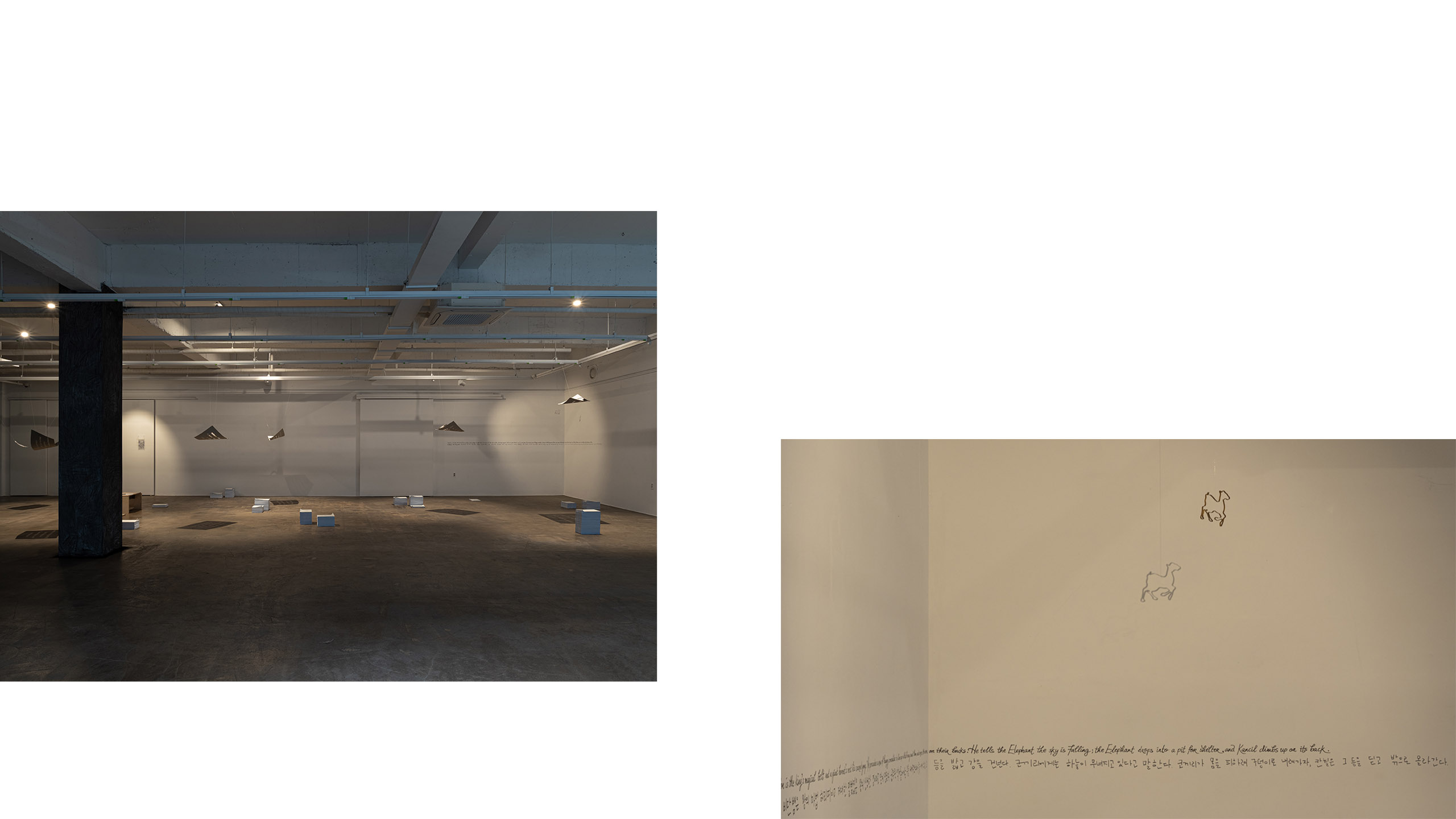
Nuntun
—to be led where return is possible
Knowledge holds its form once written down and waits to be retrieved. Wisdom behaves differently. How does what we know become something we live by? It is earned in the receiving and embodied in the doing, remade slightly by each relationship that carries it. In an era when there has never been more to know, or less time in which anything is allowed to reach us, the difficulty is no longer access but staying long enough. Time alone teaches nothing. Receptivity is cultivated only by returning to something and remaining with it, until wisdom registers and can be handed on, from one body to another.
Javanese has a verb for this kind of remaining: nuntun, to lead by the hand, an action that can be done neither at a distance nor alone. ikkibawiKrrr were on the receiving end of it before they were anything else.
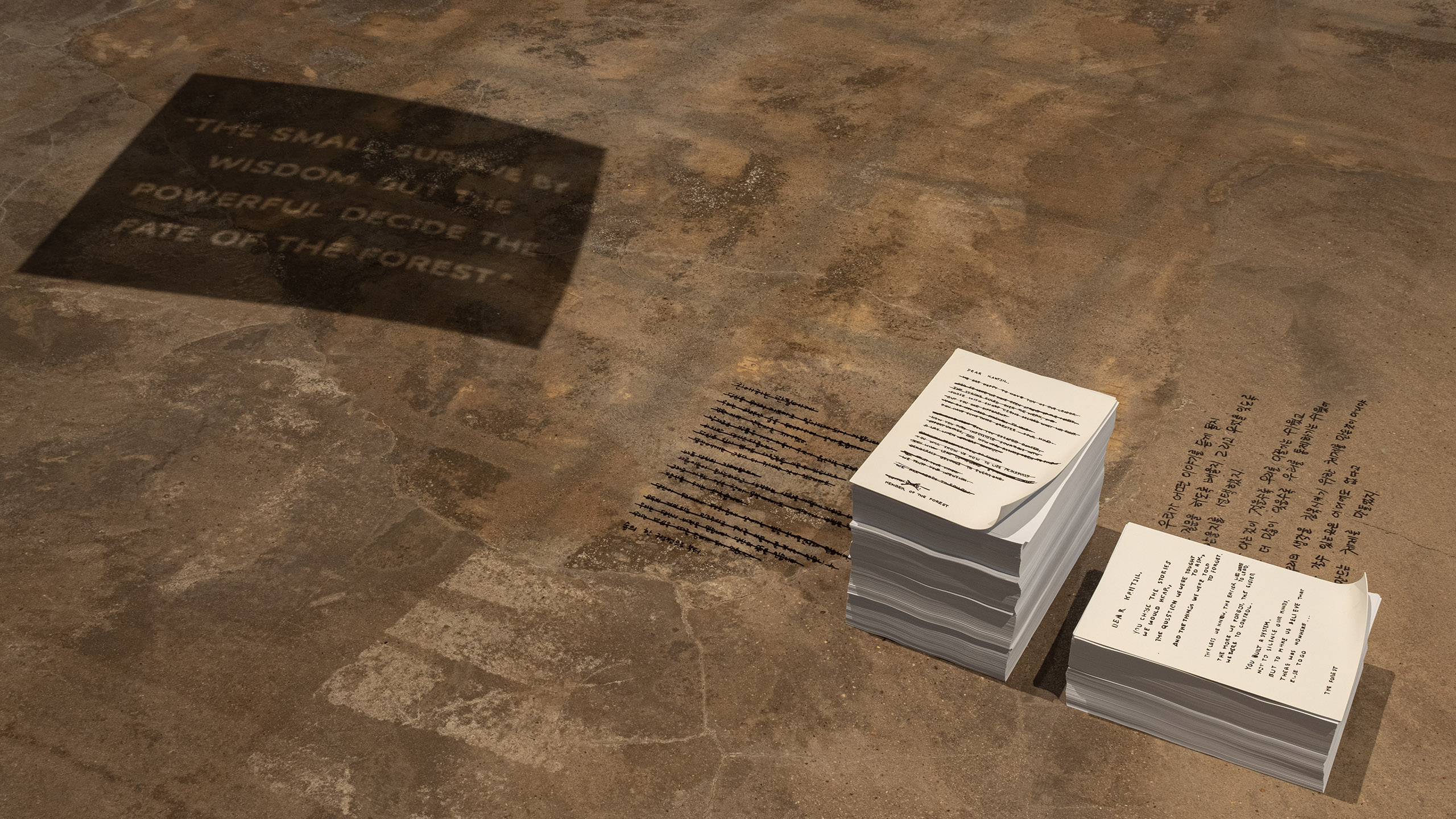
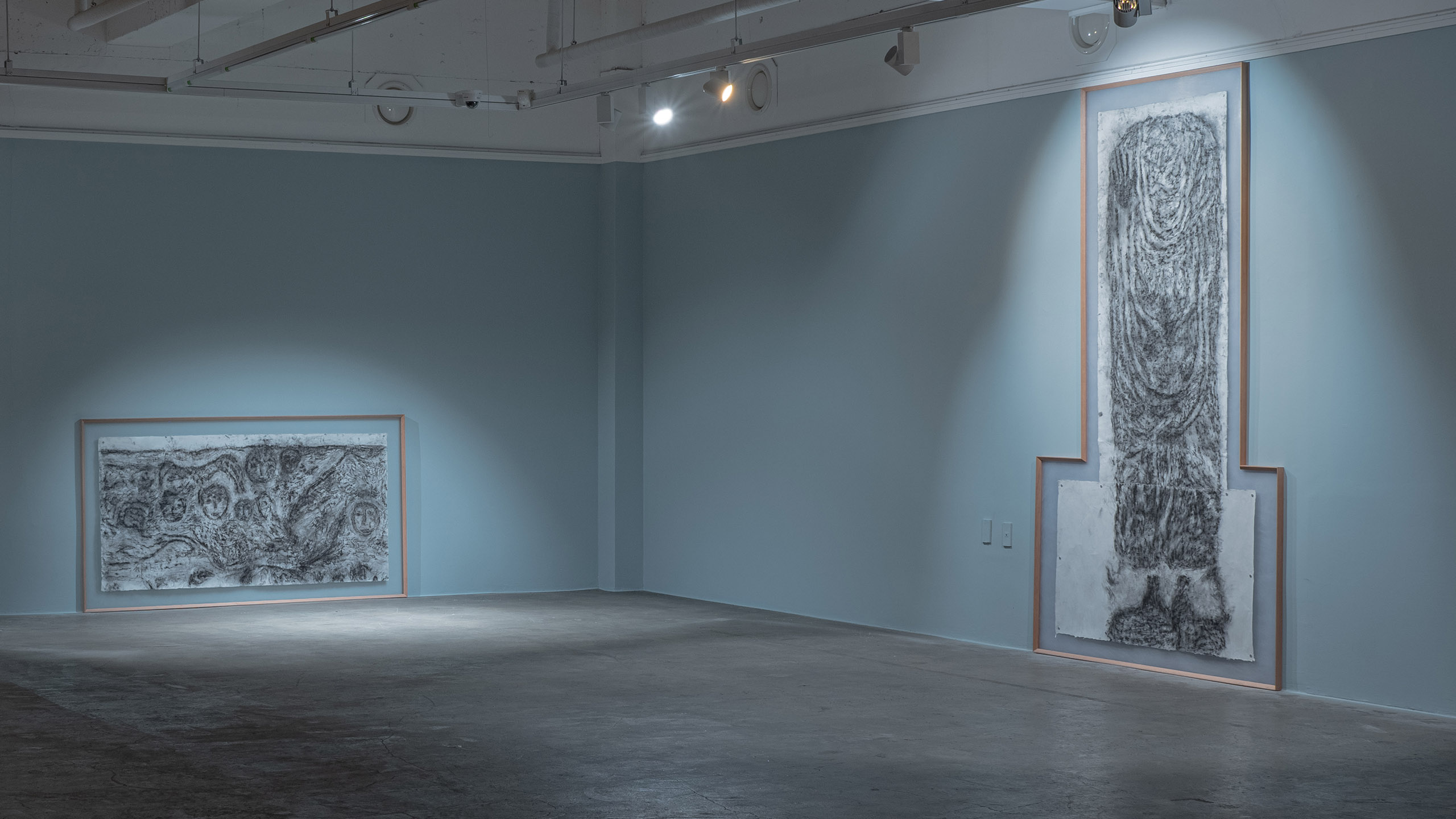
Nata
—to hold by means of letting go
Every piece of wisdom that reaches us arrives in an arrangement someone has put it in. Before it becomes a tool for moral and social instruction, whether spoken, sung, carved, or printed, it is given a sequence: one word before another, this part at the opening and that one withheld until the end.
Nata is the Javanese verb for that act: to hold things in relation, deciding what stays and what goes away. It is also a Javanese noun for king: to arrange is to hold authority over what is arranged. Aditya Novali has held that authority. From the age of seven he trained as a dalang cilik, a child puppet master in wayang, Indonesian shadow theatre; in 1989 he performed alone at the presidential palace before a formal state audience, commanding every movement on the screen and every character’s voice. He learned that position early and from the inside, observing how much narrative a single pair of hands can keep. He has not been a dalang for a long time.
ARTISTS
Born 1978, Surakarta, Indonesia
Lives and works in Surakarta, Indonesia
Aditya Novali is a multidisciplinary artist whose practice confronts a world of perpetual flux in identities and values. His sensibilities and aesthetics draw predominantly on two formations, by his background in architecture and his training as a dalang cilik (child puppet master). These variously inspire his engagements with structures, light, and space, exploring themes of boundaries, identity, materialism and urban life.
Novali received his Bachelor of Engineering in Architecture from Parahyangan Catholic University, Bandung, Indonesia, in 2002; and an IM Master of Conceptual Design from the Design Academy Eindhoven, The Netherlands, in 2008. Novali’s work has been exhibited in numerous galleries and institutions both locally and internationally. Selected solo exhibitions include Ends at Nova Contemporary, Bangkok, Thailand (2024); New Obsolescence: ADITYAVOVALI at ROH, Jakarta, Indonesia (2023); WHY at Tumurun Museum, Solo, Indonesia (2022); ME:DI:UM with ROH Projects at Liste Art Fair, Basel, Switzerland (2019); Significant Other at ShanghArt Gallery, Singapore (2019); Caprice with ROH Projects at Art Basel Hong Kong: Discoveries, Hong Kong (2018); and ACRYLIC at ROH Projects, Jakarta, Indonesia (2016). Notable group exhibitions are, among others, Pointing to the Synchronous Windows at Museum MACAN, Indonesia (2025); Taipei Biennial 2023: Small World at Taipei Fine Arts Museum, Taipei, Taiwan (2023); Dhaka Art Summit: বন্যা/Bonna at Bangladesh Shilpakala Academy, Dhaka, Bangladesh (2023); On Muzharul Islam: Surfacing Intention at Dhaka Art Summit: Seismic Movements, Dhaka, Bangladesh (2020); The 9th Asia Pacific Triennial of Contemporary Art, QAGOMA, Brisbane, Australia (2018); DIASPORA: Exit, Exile, Exodus of Southeast Asia at MAIIAM Contemporary Art Museum, Chiang Mai, Thailand (2018); The 15th Asia Art Festival: Multiple Spectacle Art from Asia at Ningbo Art Museum, Ningbo, China (2017); Imaginary Synonym at Tokyo Wonder Site, Tokyo, Japan (2016); Aku Diponegoro at National Gallery of Indonesia, Indonesia (2015); Shout! Indonesian Contemporary Art at Museo d’Arte Contemporanea (MACRO), Italy (2014); Little Water at Dojima River Biennale, Osaka, Japan (2013); and South East Asia (SEA)+ Triennale at National Gallery of Indonesia, Indonesia (2013). Novali was nominated for Best Emerging Artist Using Installation at the 2016 Prudential Eye Awards in Singapore; Finalist in the 2010 Sovereign Asian Art Prize, and awarded Best Artwork in the Bandung Contemporary Art Awards (BaCAA) in the same year.
View Artist